Cart
0
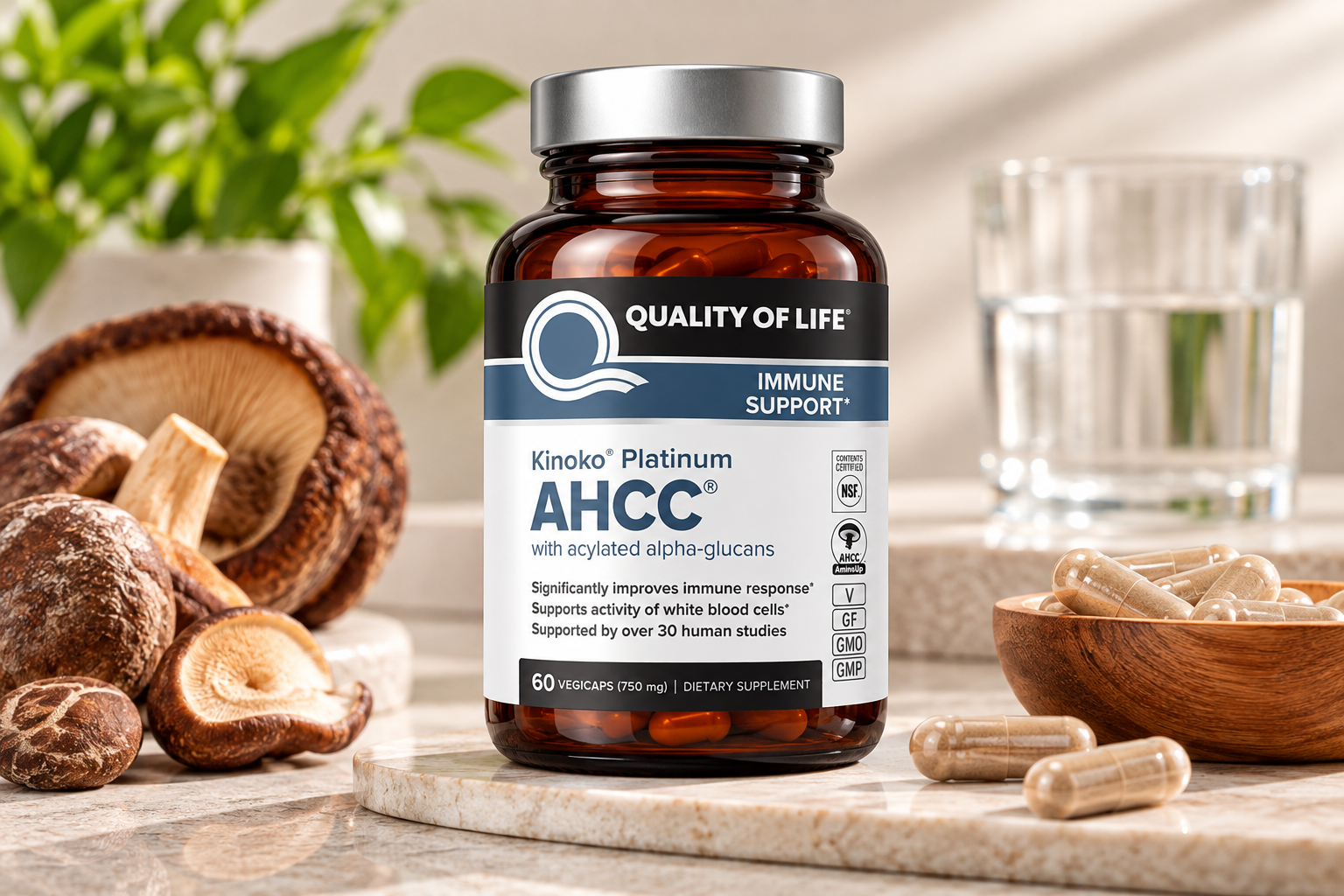
Mushroom supplements are everywhere, but Quality of Life Kinoko Platinum AHCC is built around something more specific than a generic mushroom blend.
Its main ingredient is AHCC (Active Hexose Correlated Compound), a proprietary cultured extract derived from the mycelia of Lentinula edodes, the species commonly known as shiitake. Each vegetarian capsule provides 750 mg of AHCC, while the labeled two-capsule serving delivers 1.5 grams.
The manufacturer positions the supplement primarily around immune support and maintaining healthy immune-cell activity. AHCC has also been investigated in human clinical studies, although research into specific health outcomes is still developing and should not be confused with evidence that the supplement can prevent or treat disease.
So what exactly are you getting with Kinoko Platinum?
First, AHCC Isn't Simply Powdered Shiitake

Seeing Lentinula edodes on the label could make this look like another shiitake supplement, but there is an important difference.
AHCC is produced from cultured mushroom mycelia—the root-like structures of fungi—using a proprietary manufacturing process. The resulting extract contains acetylated alpha-glucans and other components.
Quality of Life states that its AHCC has a molecular weight below 5,000 daltons, a characteristic the company associates with improved absorption compared with many conventional mushroom extracts.
That specialization is one reason Kinoko Platinum is better compared with other AHCC products than with inexpensive mushroom powders.
Why 750 mg Per Capsule Matters
Kinoko Platinum is the higher-potency option within Quality of Life's standard AHCC lineup.
Each capsule supplies 750 mg, compared with 500 mg per capsule in the company's Kinoko Gold product. The underlying AHCC raw material is otherwise the same, according to the manufacturer.
The official serving size is two capsules, providing 1.5 grams of the AHCC proprietary blend. Quality of Life recommends two capsules before a meal, up to twice daily, meaning the labeled daily range is two to four capsules.
At four capsules, the daily amount reaches 3 grams.
The manufacturer notes that human studies have investigated AHCC at daily amounts ranging from approximately 1 to 3 grams, although study doses and outcomes vary depending on what researchers were investigating.
The Immune-Support Angle Needs Some Context

Quality of Life markets Kinoko Platinum for immune support, including support for natural killer (NK) cells, macrophages, dendritic cells, and other components of immune function.
AHCC has attracted scientific interest in this area, and the manufacturer says the ingredient is supported by more than 30 human clinical studies.
However, immune-system research is complex.
Evidence that an ingredient influences an immune marker does not automatically establish that taking the supplement will prevent an infection, cure an illness, or produce a noticeable benefit in every healthy person.
The NIH-hosted product label carries the standard dietary-supplement disclaimer that its claims have not been evaluated by the FDA and that the product is not intended to diagnose, treat, cure, or prevent disease.
That is an important distinction when evaluating AHCC products marketed around immunity.
A Surprisingly Short Ingredient List
Kinoko Platinum keeps the formula relatively focused.
The AHCC proprietary blend contains cultured Lentinula edodes mycelia extract along with carnauba plant wax, tapioca dextrin, plant cellulose, and vegetable alpha-cyclodextrin. Other ingredients are hypromellose for the capsule and leucine.
There is no huge mixture of unrelated vitamins, herbs, or minerals.
That makes the product easier to understand: people are primarily buying it for AHCC rather than for a kitchen-sink supplement formula.
The capsules are vegetarian, and Quality of Life lists the product as dairy-free, gluten-free, GMO-free, and magnesium-stearate-free.
One Bottle May Not Last as Long as You Expect
The bottle contains 60 vegetarian capsules.
At the basic serving of two capsules daily, that works out to 30 days. But someone following the upper labeled amount of four capsules daily would finish the same bottle in approximately 15 days.
This matters because AHCC supplements tend to be substantially more expensive than basic mushroom powders.
The higher 750 mg concentration reduces the number of capsules required compared with lower-dose formulations, but consistent higher-dose use can still become costly.
Kinoko Platinum AHCC: Pros and Cons
| Pros | Cons |
|---|---|
| Provides a concentrated 750 mg of AHCC per capsule | More expensive than conventional mushroom supplements |
| AHCC has been investigated in multiple human clinical studies | Research does not establish every marketed or assumed health benefit |
| Focused formula without a long list of unrelated supplements | Four capsules per day makes a 60-count bottle last only about 15 days |
| Vegetarian, gluten-free, dairy-free, and GMO-free | Proprietary blend does not provide separate amounts for every component |
| Higher concentration than the company's 500 mg Kinoko Gold capsules | Not intended to diagnose, treat, cure, or prevent disease |
Who Might Consider Kinoko Platinum?
This product is aimed primarily at adults specifically interested in AHCC, rather than people simply looking for a general mushroom complex.
The 750 mg capsules are particularly convenient if you want to reach the manufacturer's higher daily AHCC amounts without taking as many capsules as a lower-potency formula would require.
Because AHCC is an immune-active supplement, people taking prescription medication, managing a medical condition, or who are pregnant or breastfeeding should discuss supplementation with a qualified healthcare professional before use. The product's retail labeling likewise advises medical consultation in these circumstances.
Final Take: Specialized Rather Than All-Purpose
Kinoko Platinum's biggest advantage is its focus.
Instead of combining a dozen mushroom species with vitamins and herbs, Quality of Life concentrates on a proprietary AHCC extract at 750 mg per capsule. Two capsules provide 1.5 grams, while four provide the 3-gram daily amount highlighted by the manufacturer for advanced immune support.
There is legitimate human research interest surrounding AHCC, particularly its interaction with aspects of immune function. At the same time, consumers should separate those findings from stronger claims that the available evidence does not establish.
For someone specifically looking for a high-potency, research-backed AHCC formulation, Kinoko Platinum offers a straightforward and relatively concentrated option—the main trade-offs are cost and the number of capsules required at the upper daily serving.
FAQs
1. How much AHCC is in one Kinoko Platinum capsule?
Each vegetarian capsule contains 750 mg of AHCC.
2. How many Kinoko Platinum capsules should you take?
The manufacturer suggests two capsules before a meal, up to twice daily.
3. How long does a 60-capsule bottle last?
It lasts 30 days at two capsules daily or approximately 15 days at four capsules daily.
4. Is Kinoko Platinum vegetarian?
Yes, Quality of Life identifies the product and its capsules as vegetarian.
5. Is AHCC the same as ordinary shiitake mushroom powder?
No, AHCC is a proprietary cultured mycelial extract derived from Lentinula edodes and produced using a specialized process.


Featured in this review

iboughtthis
4-in-1 Turmeric and Garlic Supplements with BioPerine
$23.95
View Deal on Amazon
We may earn a commission when you buy through this link, at no extra cost to you.